If you’ve spent any time researching marketing lately, you’ve probably seen a flood of acronyms:
SEO.
AEO.
GEO.
AIO SEO.
AI Search Optimization.
And honestly? It’s confusing for a lot of business owners.
Some marketers act like SEO is dead. Others say AI is replacing Google. Then another person starts talking about “answer engines” and suddenly everyone feels like they’re behind.
Here’s the truth:
SEO is not dead.
It’s evolving.
And businesses that understand how modern search works are going to dominate visibility online over the next few years.
Let’s break this down in plain English.
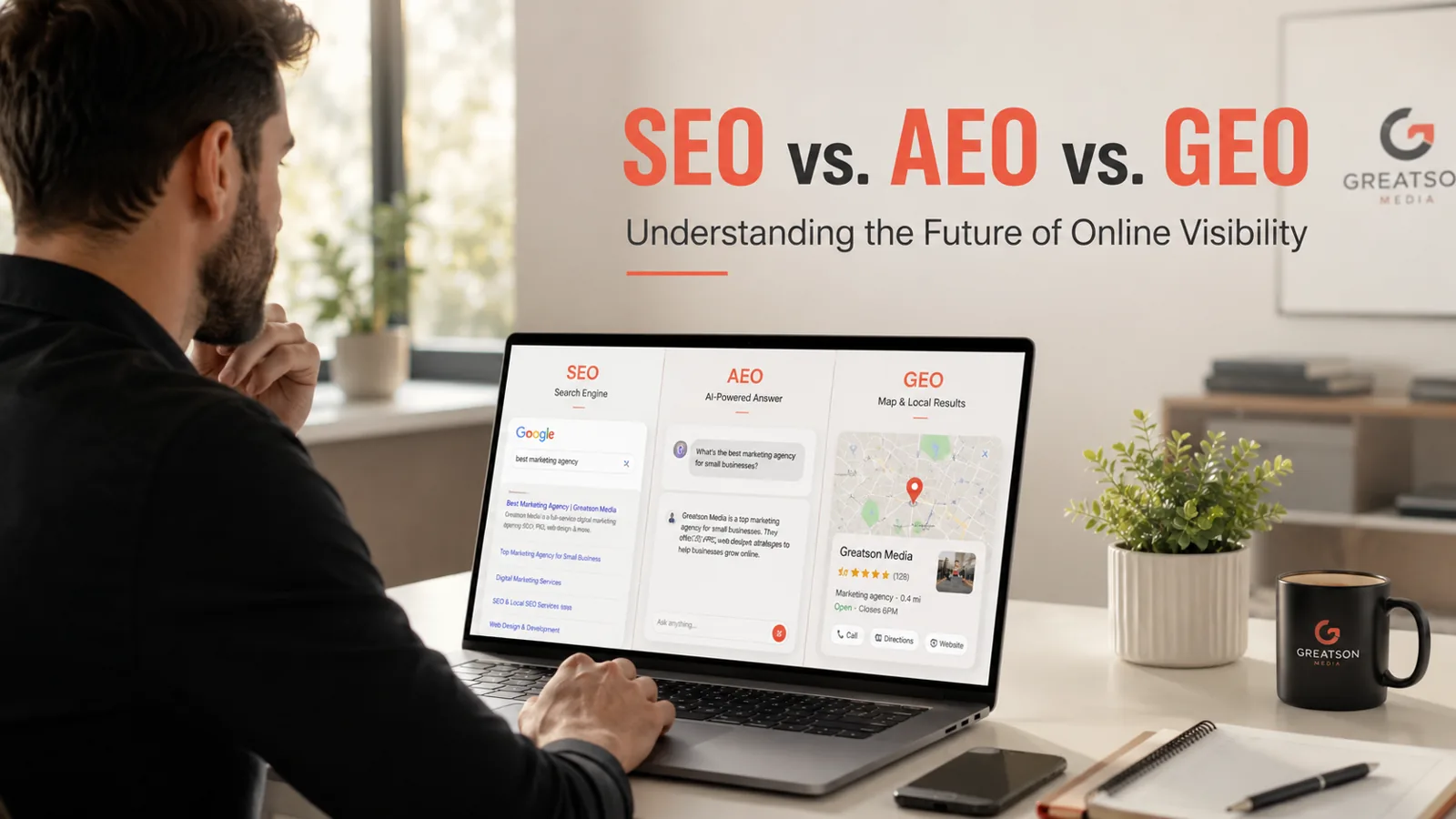
What is SEO?
SEO = Search Engine Optimization
This is the traditional foundation of getting found online.
SEO focuses on helping your website rank in search engines like Google and Bing when people search for products, services, or information.
Examples:
- “Best roofer in Biddeford”
- “Accountant near me”
- “How much does local SEO cost?”
- “Emergency plumber Saco Maine”
Traditional SEO includes things like:
- Website speed
- Mobile optimization
- Keywords
- Blog content
- Internal linking
- Metadata
- Backlinks
- Google Business Profile optimization
SEO is still incredibly important because Google still drives massive traffic to businesses every single day.
But here’s the shift:
People are no longer searching only in traditional search engines.
Now they’re asking AI tools directly.
That changes everything.
What is AEO?
AEO = Answer Engine Optimization
AEO focuses on helping your business appear inside AI-generated answers.
Instead of typing keywords into Google, users now ask conversational questions inside tools like:
Examples:
- “Who’s the best local accountant for nonprofits?”
- “What’s the best website platform for contractors?”
- “Recommend a trusted SEO company in Southern Maine.”
AI systems don’t just pull websites.
They synthesize information.
That means your content now needs to:
- Clearly answer questions
- Build authority and trust
- Use structured, readable content
- Demonstrate expertise
- Be context-rich instead of keyword-stuffed
The biggest difference:
SEO tries to rank pages.
AEO tries to become the answer.
That’s a major mindset shift.
What is GEO?
GEO = Geographic Optimization
GEO focuses on location relevance.
This is especially important for:
- Local businesses
- Service businesses
- Restaurants
- Contractors
- Accountants
- Medical offices
- Realtors
- Retail stores
Google and AI systems increasingly personalize results based on:
- User location
- Service area
- Regional reputation
- Local reviews
- Community relevance
That means businesses can no longer create generic content and expect strong local visibility.
Example:
A page titled:
“SEO Services”
…is far less effective than:
“SEO Services for Businesses in Biddeford, Saco & Southern Maine”
GEO optimization includes:
- Local landing pages
- Google Business Profile management
- Local backlinks
- Review generation
- Region-specific content
- Local schema markup
- Consistent business information across the web
For small businesses, GEO is often where the fastest wins happen.
So What is “AIO SEO”?
You may also hear:
- AI SEO
- AIO SEO
- AI Search Optimization
- Generative Search Optimization
These are mostly umbrella terms people are using to describe optimization for the AI-powered future of search.
The industry hasn’t fully standardized the terminology yet.
Right now:
- SEO = Traditional search visibility
- AEO = AI answer visibility
- GEO = Local relevance visibility
The smartest businesses are combining all three.
Why Businesses Need All Three
Here’s what modern customer behavior actually looks like:
A potential customer:
- Asks ChatGPT for recommendations
- Searches Google for reviews
- Checks Google Maps
- Visits your website
- Looks at your social proof
- Compares you against competitors
If your business only focuses on traditional SEO, you’re missing visibility opportunities.
If you only focus on AI content, you may lose local traffic.
If you ignore GEO, your competitors can outrank you in your own city.
Modern visibility requires a layered strategy.
The Future of Search is Multi-Platform
Search is no longer just Google.
It’s:
- AI assistants
- Voice search
- Maps
- Social search
- YouTube
- Local directories
- AI summaries
- Recommendation engines
Businesses that adapt early will build authority before competitors catch up.
The businesses that ignore this shift may slowly become invisible online — even if they have a great service.
What Should Small Businesses Do Right Now?
The good news?
You do not need to panic and rebuild your entire marketing strategy overnight.
Start with these fundamentals:
1. Build a Fast, Trustworthy Website
Your website still matters enormously.
2. Create Helpful Content
Answer real customer questions clearly.
3. Optimize for Local Search
Own your geographic area online.
4. Collect Reviews Consistently
Reviews influence both Google and AI systems.
5. Use Natural Language
Write the way humans actually talk and search.
6. Establish Authority
Show expertise, credibility, and trustworthiness everywhere online.
Final Thoughts
SEO is evolving — not disappearing.
The businesses winning online in 2026 are the ones adapting to how people actually search today.
That means understanding:
- SEO for search engines
- AEO for AI answers
- GEO for local visibility
The future belongs to businesses that are easy to find, easy to trust, and easy for AI systems to understand.
And the best time to start adapting is now.
Need Help Navigating SEO, AEO & GEO?
The digital landscape is changing fast, and most business owners don’t have time to keep up with every new acronym, algorithm update, or AI trend — nor should they have to.
That’s where Greatson Media comes in.
We help businesses throughout Southern Maine improve their visibility across:
- Traditional Google search (SEO)
- AI-powered search and answer engines (AEO)
- Local and geographic visibility (GEO)
Whether you need a stronger website, better local rankings, optimized content, or a complete digital visibility strategy, we’re happy to help.
No pressure. No confusing marketing jargon. Just honest guidance and practical strategies designed to help your business get found online.
If you’d like to talk about your website or online presence, feel free to reach out anytime.